A screenshot that’s been living in my head
A few days ago someone reshared a post titled “My senior engineers have stopped thinking for themselves.” You’ve probably seen it too. It went around. A developer, three years at a company, watching the people who taught them everything turn into routers for AI output. The tech lead who used to whiteboard system designs for hours now drops a PR described as “refactored auth flow based on ChatGPT output,” and when asked to explain it, says “just paste it into ChatGPT and ask it to explain.” Another senior approving PRs in three minutes flat by pasting the diff into a chat window, until the day the chat window said “looks good” and a race condition shipped to prod.
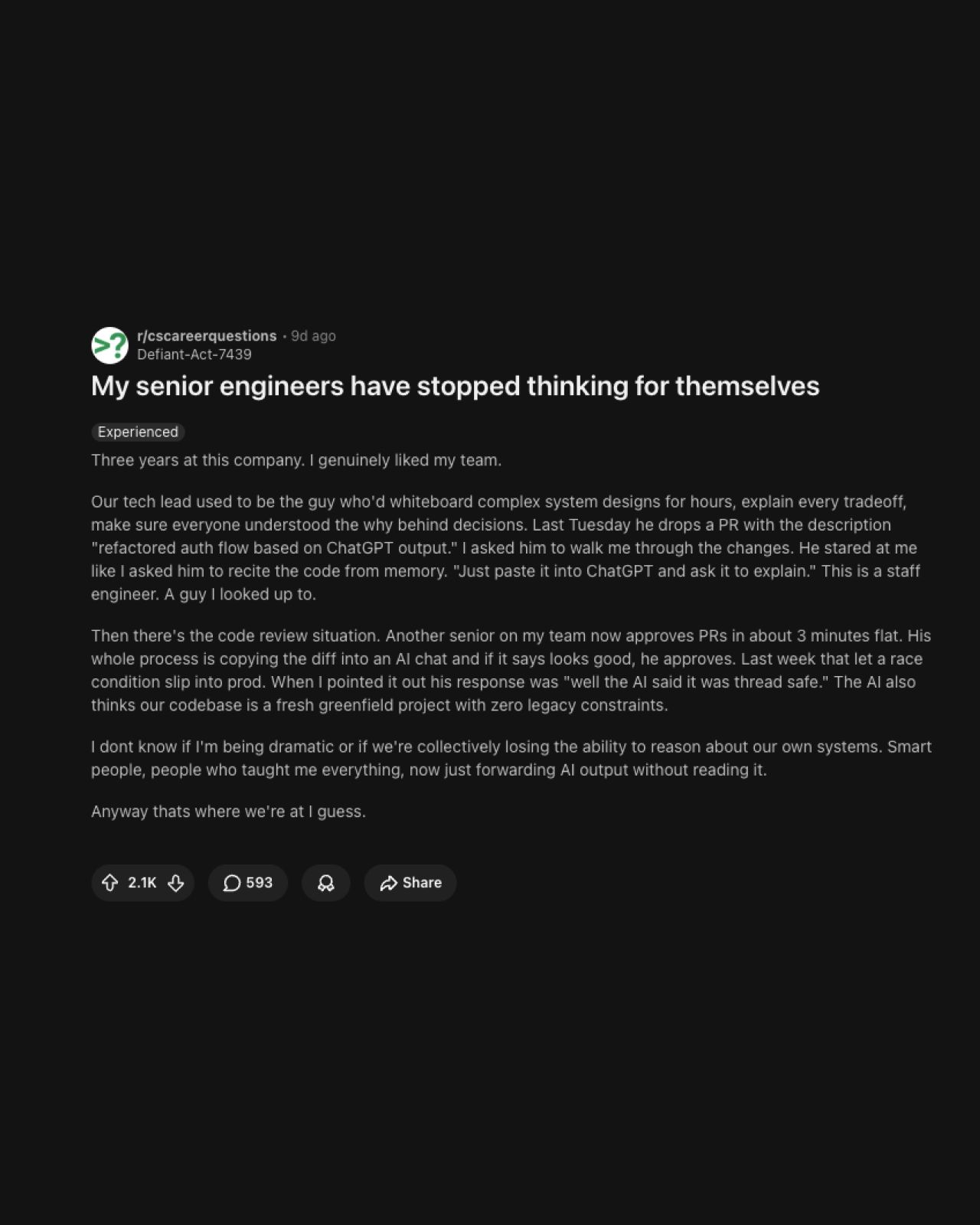
The post resonated with thousands of people. And I sat with it for a while, because I’m two years into this field (three if you count the internship), and I realised something uncomfortable. I’m not the author of that post. Depending on who you ask, I’m one of the people it’s warning you about.
Except I don’t think that’s the real story. I think the real story is messier, and it’s the one I actually want to write down, because nobody around me seems to want to say it out loud.
The two eras I’ve lived through
Let me be precise about the timeline, because it matters.
I started as an intern in what I now think of as the pre-agentic era. Stack Overflow was the oracle. You opened fourteen tabs, you read the accepted answer and then the angry comment below it that explained why the accepted answer was subtly wrong, you read the docs, and you read the source when the docs lied. Learning was slow and physical. You earned understanding by grinding against it. When you finally got something, it was yours. Nobody could take it from you, because it had cost you something.
I was, honestly, a dumb kid back then. Not stupid. Just empty. I copied patterns I didn’t understand and shipped things that worked for reasons I couldn’t have explained if you’d put me on the spot. The gap between “it runs” and “I know why it runs” was huge, and I lived in that gap for a long time.
Then the ground moved, in stages. First the autocomplete got scary good. Then, around late 2022 into 2023, the chat models showed up and ChatGPT was suddenly on everyone’s second monitor. But that was still the copy-paste era, and people forget this. You described your problem in a chat window, it handed you a block of code, and you were the integration layer. You ferried context in by hand, pasted the answer back into your editor, and fixed whatever it got wrong about a codebase it had never seen. Faster than fourteen Stack Overflow tabs, sure, but the loop still ran through your fingers.
Then the agents arrived, and that’s the part that actually changed everything. The CLI-native tools, the Codexes and Claude Codes of the world. They didn’t just answer a question. They held a goal, read your codebase, ran your tests, opened a PR, read the failure, and tried again. The human stopped being the copy-paste middleman. The loop closed. The thing stopped being a fancy search engine you had to spoon-feed, and started being a collaborator that could be wrong in genuinely interesting ways.
And here’s the part I’m quietly proud of. I didn’t use any of it to stop thinking. I used it to think faster.
What “researching extensively” actually means now
When people hear “I use AI a lot,” they assume I mean the thing in the screenshot. Paste, copy, ship, forget. That’s not what I do, and the difference is basically the whole point of this post.
What I actually do looks more like this. I form a hypothesis about how something works. I ask the model to argue with me about it. Then I go and verify the claim myself, in the docs, in the source, or in a throwaway script that proves or disproves it. Usually I end up reading two or three primary sources the model would never have surfaced on its own. And then I come back with something I can actually defend in a room full of people who disagree with me.
The model isn’t my answer. It’s the fastest way I’ve ever found to generate good questions. It compresses the part of research that used to be pure friction, the bit where you’re just trying to find the thread to pull, so I can spend my actual attention on the part that matters, which is judgement.
In two years I’ve probably read more deeply than I would have in five during the old era. Not because the AI did the reading for me. Because it cleared the brush so I could see where the reading needed to happen. I’ve gone from the kid who copied patterns to someone who can sit down, do the work, and arrive at a position he’s actually earned.
So you can probably imagine the specific flavour of frustration when that position gets waved away by someone who did none of that work.
The thing that actually stings
Here’s the pattern that’s been eating at me, and it’s almost the exact inverse of the viral screenshot.
I do the research. The slow kind. The read-the-RFC, read-the-changelog, write-the-repro kind. I show up with a conclusion I can back three layers deep. And then someone, often more senior, often someone I genuinely respect, pastes my point into a chatbot, reads the first paragraph it spits back, and tells me I’m wrong.
Not “here’s a source that contradicts you.” Not “I tested it and got a different result.” Just: the AI said so.
And I’m supposed to defer to that. Because they’re senior. Because they’ve got years on me. Because that’s how it’s always worked.
Let me be careful here, because I don’t want to be the junior who thinks experience is worthless. Experience is the most valuable thing in this industry. The senior who’s watched three migrations fail knows things I can’t get out of any model. But experience isn’t the same as being right, and seniority isn’t a substitute for having done the work on the specific question in front of you.
The irony of this particular moment is that the loudest warnings about AI making engineers lazy are sometimes coming from the people doing the laziest possible thing with it. They haven’t stopped using AI. They’ve stopped using it well. They’ve outsourced the one part of the job that was never supposed to be outsourced, the judgement, while keeping all the authority that judgement was supposed to earn them.
That’s the asymmetry that gets me. A junior who fact-checks an AI is doing real work. A senior who fact-checks a human with an AI, and stops at the first confident-sounding paragraph, isn’t. And yet the second one wins the argument by default, because the hierarchy assumes he already did the thinking.
”Why should I listen to you?”
There’s a feeling I’ve had more than once, and I think it’s the same feeling the author of that screenshot had, just pointed the other way. It’s the feeling of watching authority and competence quietly come apart from each other.
The honest, slightly ugly question that comes up in those moments is: why should I listen to you?
I’ve tried to actually sit with that question instead of just feeling it, because it’s a dangerous one. It’s the question that turns a sharp junior into an insufferable one. So let me try to answer it fairly, in both directions.
Why I should listen to a senior, even when I think they’re wrong:
- They’ve got context I don’t. They know which past decisions are load-bearing and which ones are just accidents nobody had time to fix.
- They’ve seen the failure I’m about to walk into. The race condition. The migration that looked fine in staging. The “clever” abstraction that turned into a five-year liability.
- They carry the consequences. When it breaks at 3am, it’s often their pager, their reputation, their awkward conversation with the VP.
- Being right is cheaper than being effective. I can win the technical argument and still lose, because I torched the relationship I needed to actually ship the fix.
Why a senior should listen to me, even though I’m only two years in:
- I did the work on this specific thing. Tenure doesn’t transfer. Twelve years of general experience doesn’t automatically beat twelve focused, verified hours on the exact question we’re arguing about.
- I live closer to the new tools. Not because I’m younger, but because I refused to treat them as a threat and decided to treat them as a craft worth getting good at.
- “The AI said so” isn’t an argument, and I’m not going to pretend it is one just because a senior person is the one saying it.
- Adapting isn’t optional anymore. The half-life of a specific technical fact has collapsed. The thing that was best practice eighteen months ago is now the thing the model confidently recommends while being wrong.
Both of those lists are true at once. That’s the whole difficulty.
The real failure isn’t AI. It’s refusing to adapt.
There’s one line I keep coming back to, and I want to make it the spine of this whole thing:
You might be a senior. You might have a decade of experience. But you still need to adapt.
The screenshot frames the crisis as “AI is making smart people stop thinking.” I think that’s half right and half a comfortable story. The comfortable half lets experienced engineers off the hook, because it says the problem is the tool and not the person. But the tool didn’t make that staff engineer stop explaining his decisions. It just removed the friction that used to force him to. The laziness was always available. The model only made it cheap.
And the same is true on my side of the table. The model didn’t make me a better researcher. It removed the friction that used to make deep research expensive. I could have spent that freed-up time shipping slop faster. I chose to spend it reading more. What you do with the friction the AI removes, that’s the whole game now. It’s the new measure of an engineer.
So the dividing line in this industry isn’t senior versus junior. It isn’t pre-AI versus post-AI. It’s people who use AI to think more versus people who use it to think less, and that line runs straight through every level of seniority, including mine.
The author of that screenshot and I are probably on the same side of it. We’re both frustrated by people forwarding AI output without reading it. We just happened to be standing at different points in the hierarchy when the frustration hit, so it came out looking like two opposite complaints.
What I’m actually going to do about it
Feeling righteous is a trap. It’s the most seductive trap available to a competent person who feels unheard, and I’ve watched it ruin people. So instead of just being frustrated, here’s what I’m trying to hold myself to. I’m writing it down so I can be held to it.
Bring receipts, not vibes. When I disagree, I don’t say “I researched this.” I show the source, the repro, the test that proves it. Make the work legible. The senior who dismissed me with a chatbot paragraph has a much harder time dismissing a failing test that’s got his name on the line.
Separate being right from being heard. These are two different jobs, and for a long time I only did the first one. Being right is the easy 20%. Getting a room full of humans to actually act on it is the hard 80%, and no amount of correctness lets you skip that part.
Steelman the senior. Before I decide someone has stopped thinking, I assume they have context I’m missing, and I ask for it. Sometimes the “obviously wrong” call really is wrong. Sometimes it’s load-bearing in a way I just couldn’t see. I want to know which one it is before I plant a flag.
Refuse “the AI said so” from everyone, including me. This is the one I’m strictest about. The second I catch myself ending an argument with the model’s authority instead of my own verified understanding, I’ve become the thing in the screenshot. The tool is an instrument. The judgement has to stay mine.
Stay generous about adaptation. The senior who’s fumbling with these tools right now isn’t stupid. He’s doing the hardest thing a competent person can do, which is being a beginner again, in public, after years of being the expert in the room. I want to remember how that feels, because in five years it’ll be my turn. Something will shift under me, and some twenty-three-year-old will adapt to it faster than I do, and I’ll have to decide whether I meet that with curiosity or with my title. I’d like to already know my answer.
To the version of me that’s still frustrated
If you’re reading this and you recognise the feeling, the researched-it-cold-and-got-dismissed feeling, the why-should-I-listen-to-them feeling, here’s the thing I most want to say.
The frustration is real and it’s mostly fair. You probably did do the work. You’re probably right on this specific point. Don’t gaslight yourself into thinking the speed at which you adapted is some kind of flaw, or a cheat code. Gaining fast isn’t something to regret. It’s what the moment asked for and you answered it.
But the frustration is also a fork in the road. One path turns it into contempt, for seniors, for “old” engineers, for anyone slower than you. And that contempt hardens into exactly the unteachable arrogance you currently can’t stand. The other path turns it into fuel. Do the work. Bring the receipts. Stay teachable. Let the competence speak so loudly and so consistently that the hierarchy quietly reorganises itself around it whether anyone meant for it to or not.
Two years in, having lived through one era and now building inside the next one, that’s the bet I’m making. Not that I’m smarter than the people ahead of me, because I’m not. Just that the willingness to keep adapting, in public, without ego, is the only kind of seniority that survives this. The title is borrowed. The adaptation is yours.
And nobody, not the senior across the table, not the model in the terminal, gets to do that part for you.